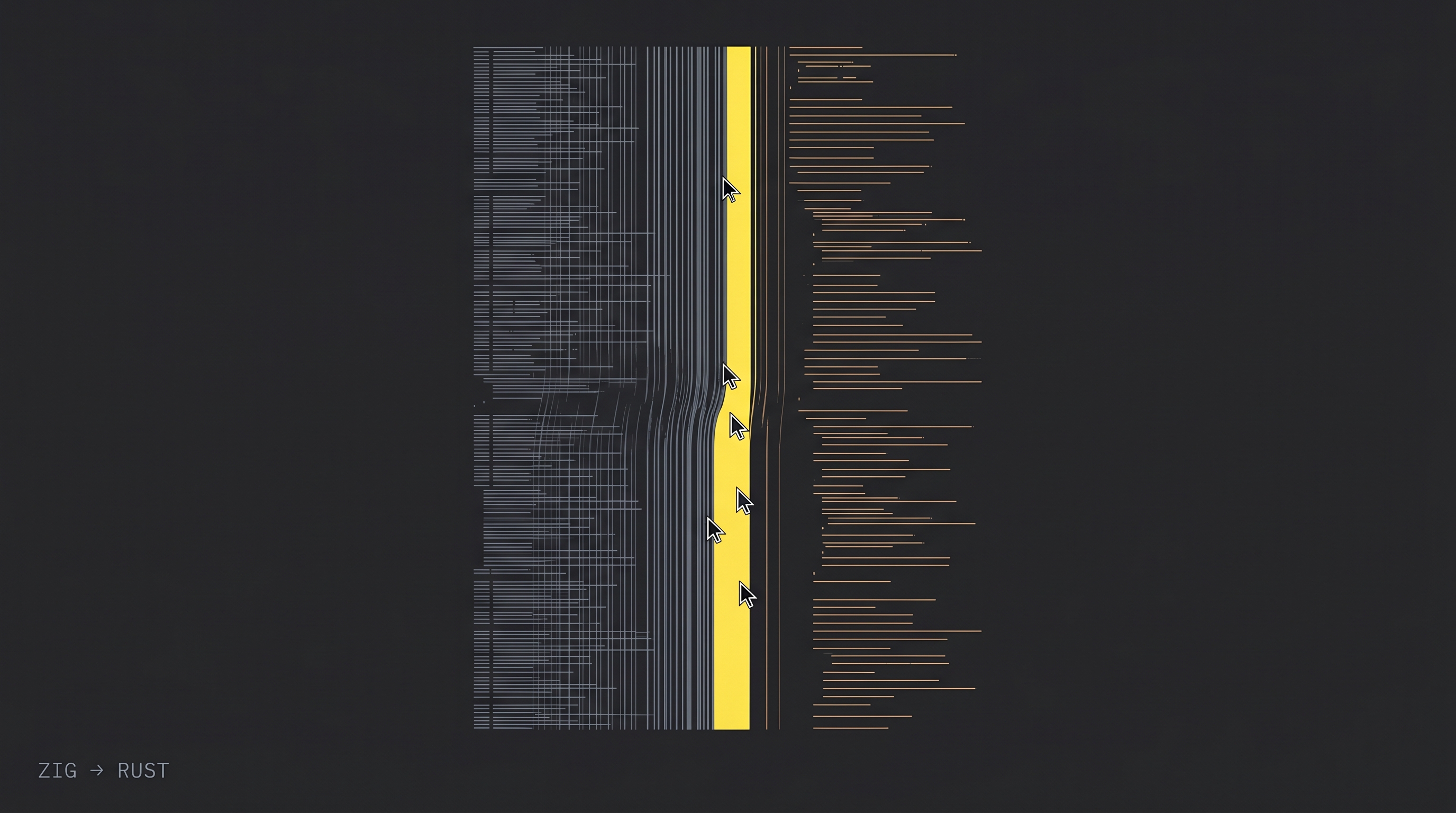
Jarred Sumner opened a pull request porting Bun, the JavaScript runtime Anthropic acquired last year, from Zig to Rust — roughly 966,000 lines, largely AI-generated, that already pass the test suite on every platform and ship a neutral-to-faster binary 3 to 8 MB smaller via bun upgrade --canary. Sumner says the point isn't speed: "we now have compiler-assisted tools for catching & preventing…
Read source◆ Braid Daily · 2026-05-14
Bun ported from Zig to Rust passes canary in a week
A ~966,000-line port of the Bun runtime, largely AI-generated, already passes the test suite on every platform.
The lead
1
Reading the Bun diff
2DevClass: Anthropic's Bun team trials the port
DevClass
DevClass traces the port to a roughly 300-rule porting guide and a two-phase plan, with Claude-powered agents doing the bulk of the work on a branch named claude/phase-a-port. Theo Browne, reading the diff, counted about 13,000 unsafe blocks still in the ported code — and Sumner himself has downplayed the whole thing on Hacker News.
Read source“we haven't committed to rewriting. There's a very high chance all this code gets thrown out completely.”
Armin Ronacher: 'this is impressive'
Armin Ronacher (@mitsuhiko)
Ronacher amplified the pull request to his systems-and-tooling audience with a one-line endorsement, and Mario Zechner reposted it. When the Flask author calls an AI-generated runtime port impressive, the systems crowd is treating it as a data point rather than a curiosity.
Read source“Say what you want: this is impressive.”
Anthropic re-meters, then re-distributes
3Programmatic use gets its own credit, starting June 15
VentureBeat
From June 15, Agent SDK and claude -p usage on subscription plans draws from a separate monthly credit billed at API rates — roughly $20 to $200 by plan, no rollover. Exhaust it and there's no fallback to your interactive limits; you buy more. It covers the Agent SDK, claude -p, Claude Code GitHub Actions, and third-party apps like OpenClaw.
Read sourceThe community reaction: 'the 6th u-turn'
r/Anthropic
A roughly 780-upvote thread reacting to Anthropic restricting programmatic use of Claude subscriptions. The headline overshoots — it's a metering change, not a ban — but the top comment is already a workaround, running real Claude Code in tmux driven by sendkeys, and the churn itself is the complaint.
Read source“What is this, the 6th u-turn? Don't worry they'll change their mind again by next week.”
Claude for Small Business
Anthropic
A toggle install inside Claude Cowork that connects Claude to QuickBooks, PayPal, HubSpot, Canva, Docusign and the two big office suites, with 15 ready-to-run workflows and a user-approval step before anything sends, posts or pays. It aims at non-technical owners — the opposite end of Anthropic's user base from the developers running agent fleets, in the same week it re-metered them.
Read source“People run the business, and Claude helps take the late-night work off their plates.”
Harder to measure, harder to reach
4AISI: autonomous cyber capability is doubling every 4.7 months
UK AI Security Institute
AISI now estimates the length of cyber task a frontier model can complete autonomously is doubling roughly every 4.7 months, down from an earlier estimate of every 8. A newer Claude Mythos Preview checkpoint became the first model to complete its 'Cooling Tower' range. Tasks are capped at 2.5M tokens because, uncapped, the suite saturates.
Read source“success rates are so high that time horizons become impossible to calculate”
An unconfirmed wrinkle: evals behind deployment
r/singularity
The thread surfacing the AISI post adds something unconfirmed: a commenter, citing Anthropic's Logan Graham, says the tested checkpoint appears to be the one already deployed under Project Glasswing — which would put safety evaluation behind deployment. The original poster later flagged the title as possibly misleading about which checkpoint was tested.
Read sourceWeb search gets more expensive and less reliable
r/LocalLLaMA
The thread ties together two converging changes — Google capping free full-web search and Cloudflare defaulting to challenge AI bots — and reports harnesses now hitting 400-level errors across site after site. The top comment's read: providers see bot queries with no human eyes and no ad revenue, so they're closing access that was never paying for itself.
Read source“Google is reinforcing their mote by pulling up the drawbridge for aggressive pricing.”
Google ends free full-web search for Programmable Search Engine
WinBuzzer
The primary-source confirmation behind that thread: Google is ending free full-web search through Programmable Search Engine and capping the free tier at 50 domains. New engines are capped now; existing full-web engines must migrate by January 1, 2027. Paid pricing isn't public — you register interest through a form.
Read sourceCraft, post-mortems, and the slop reflex
4Building a chess coach that never lets the model think
Anant Dole & Asbjørn Steinskog, AI Engineer
Play Magnus's chess coach never lets the model reason about positions. Stockfish supplies the ground-truth best move, a battery of detectors handles tactics, and Maia predicts what a human at a given rating would actually play; the model only phrases the result. End-to-end commentary lands in about three seconds on Gemini 3 Flash.
Read source“the LLM's job is only to translate this information into English, because we really don't want it to try to figure out too much on its own”
Five years and $5M on a custom language: a post-mortem
Matija Sosic, Wasp
Wasp is replacing its custom DSL and compiler with a TypeScript SDK after five years and $5M raised. Sosic is specific about the tail costs that never appear in a design doc: editor and language-server tooling that only ever reached about 80%, a 'wasp-lang' name that made people think it wanted to replace JavaScript, and the realization that users were excited about the high-level app spec, not the bespoke syntax.
Read source“Language was never the moat. It's having a high-level understanding of your entire app at compile time.”
Post a real Monet, call it AI, watch the verdict
Jediwolf / SHL0MS
An artist posted a genuine Monet labelled as AI-generated. Commenters lined up to call it slop — soft, mushy, obviously fake — while looking at an actual Monet. The 'this is AI' reaction tracked the label, not the pixels. Marc Andreessen replied with a single '😳'.
Read source“What happens when you post a real Monet and say it's AI? The coolest art social experiment I've seen in a while.”
Cristóbal Valenzuela: Monet was the slop of his era
Cristóbal Valenzuela, Runway
Runway's CEO answered the Monet experiment with a historical point: Impressionism was itself derided in its era, and the word began as a term of contempt for work that didn't look like real painting. Coming from someone running an AI video company, it reads as standing rather than defense.
Read source“Monet was probably one of the biggest slop painters of his era and, by all means, managed to help transform the entire art world.”
Companion episode
The Cost of Finding Out
Three issues this week have now touched a Claude Mythos checkpoint — METR on Friday, AISI today — and each evaluator keeps repeating a version of the same line: the test is straining against the model, not the other way around. The Bun port and Google's search-index change point the same direction from the other side. The cost of a large rewrite fell this week while the cost of reading the open web went up.