At WWDC Apple unveiled new Apple Foundation Models: two on-device models, including a 20-billion-parameter multimodal one it calls AFM 3 Core Advanced, plus three cloud models. The detail that matters to builders is that there's now a Foundation Models command-line tool to drive them, and the revamped Siri leans on the same stack.
Read source◆ Braid Daily · 2026-06-09
Apple puts a 20-billion-parameter multimodal model on the device, and ships a CLI for it
WWDC delivers on-device foundation models and a command-line way to call them. Plus a Microsoft supply-chain hack and China's $295B compute…
The lead
1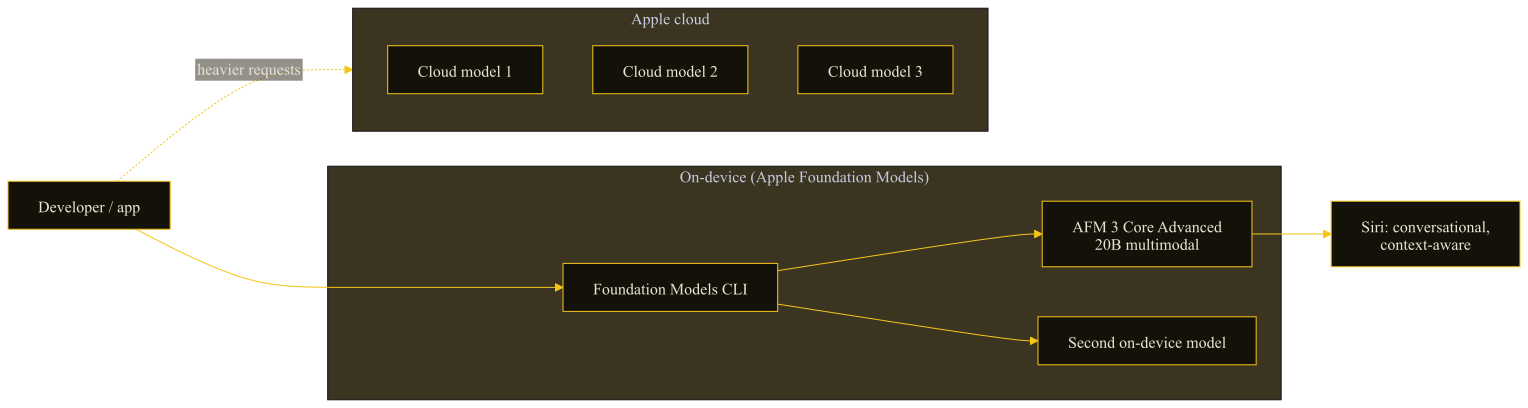
WWDC: the model moves local
4Foundation Models has a CLI
X / Connor
Connor flags the piece developers will care about most — "Foundation Models has a CLI" — meaning you can now script Apple's on-device models from the command line.
Read source“Foundation Models has a CLI”
Three MLX talks at WWDC: local agents, distributed training
X / Awni Hannun
Awni Hannun rounds up three MLX sessions on running agents on-device and on distributed inference and training — the groundwork under everything Apple announced on stage.
Read sourceSiri finally gets conversational, two years late
Axios
Ina Fried's read: Apple is delivering the context-aware assistant it promised two years ago, while rivals have already moved past assistants to agents.
Read sourceA new open-weight series built on Qwen 3.5
X / Tiezhen Wang
NexEcosystem's Apache-2.0 series ships in Pro (397B-A17B) and Mini (35B-A3B) sizes, tuned for agentic adaptive thinking and long context.
Read sourceSupply chain and agent attack surface
3Microsoft's open-source tools were hacked to steal AI developers' passwords
TechCrunch (via HN)
Attackers compromised Microsoft open-source tooling to harvest credentials from AI developers — the same dependency-trust problem behind this week's run of agent supply-chain stories.
Read sourceVATS: turning tool errors into an injection channel
arXiv
As the Model Context Protocol standardizes tool-calling, this paper shows how the error path itself becomes an attack vector, with the error message carrying implicit authority the agent trusts.
Read sourceOne detector for many LLM backdoors
arXiv
The claim: jailbreaking and bias backdoors share latent structure, so a single sparse-autoencoder method can detect and mitigate attacks usually treated as separate problems.
Read sourceCompute, geopolitics, and who gets to build
4China drafts a $295B, five-year datacenter plan
Bloomberg (via Techmeme)
The draft would spend $295 billion over five years and source more than 80% of the technology from local suppliers such as Huawei.
Read sourceTaiwan weighs cutting AI chip sales to all Chinese buyers
Bloomberg (via Techmeme)
Rather than only blacklisted entities like Huawei, Taiwan is considering restricting AI chip sales to every Chinese customer, aligning with US export measures.
Read sourceThe UK reviews its NHS contract with Palantir
Reuters (via Techmeme)
Pressure is building to terminate the deal in 2027 over reliance on US tech, a concrete test of how far sovereignty worries reshape existing contracts.
Read sourceAmazon employees ask Seattle to pause new datacenters
The Verge
The Seattle City Council votes Tuesday on a one-year moratorium on new datacenters, with some of the pressure coming from Amazon's own employees.
Read sourceEvals and the liability question
3A continuous measure of model sycophancy
arXiv
The AI Epistemic Deference Index scores how readily a model endorses a user's claim just to agree, turning a fuzzy complaint about sycophancy into something you can track.
Read sourceWhere instruction hierarchy breaks in reasoning models
arXiv
A white-box diagnostic for when reasoning models stop honoring instruction priority, tested across Gemma, Qwen, and Claude, with reported repairs for specific failure modes.
Read sourceDoctors and the NHS could be sued for AI mistakes
The Guardian
The Medical Protection Society wants the law overhauled so clinicians aren't left holding liability for errors made by the AI tools they're told to use.
Read sourceQuote worth keeping
1On why frontier benchmarks dried up
X / Susan Zhang
Susan Zhang on the economics behind the shift from public benchmarks to product-benchmarks sold directly.
Read source“agi happened when the opportunity cost of producing a meaningful frontier benchmark far far far exceeded simply* building and selling the product-benchmark directly”
Companion episode
Twenty Ways To Not Trust An Agent
We've spent the week tracking supply-chain attacks on the tools agents depend on, from config files that run code to today's compromised Microsoft tooling. The MCP error-path paper suggests the same lesson keeps arriving from a new direction: the channels an agent trusts by default are the ones worth auditing first.