Pax Silica gives the day a concrete policy lead: multiple nations coordinating around AI supply chains. Read it beside Europe’s tech-sovereignty package and the compute items below; the shared question is who controls the machines, inputs, and rules that make frontier systems possible.
Read source◆ Braid Daily · 2026-06-23
AI supply chains become state business
Pax Silica anchors the policy side of the day; pressure also shows up around Google, Oracle, GLM-5.2, and TOP500.
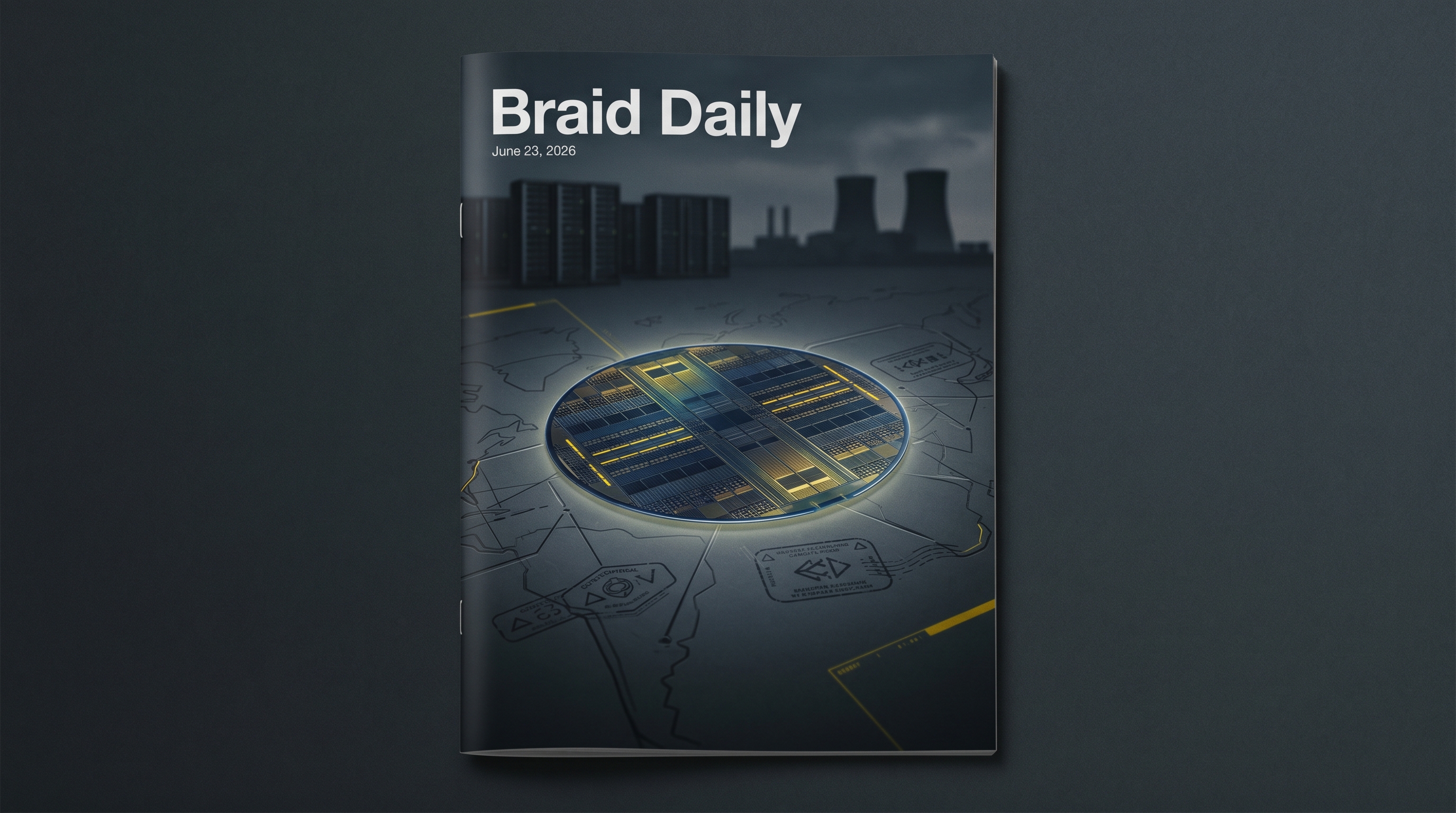
The lead
1Supply-chain control
3Europe pushes a tech-sovereignty package
IEEE Spectrum
IEEE Spectrum covers Europe’s attempt to build more of its own tech and supply-chain capacity. It pairs with Pax Silica because both items treat compute as policy infrastructure, not only company procurement.
Read sourceTOP500 gives China and NVIDIA different compute stories
Techmeme
TOP500 separates fastest-system headlines from installed-base control. Keep those two claims apart when reading the supercomputing news.
Read sourceASML’s $400 million machine stays in the bottleneck story
MIT Technology Review
ASML’s expensive lithography equipment is the hardware constraint behind the policy items. The compute supply chain still depends on a small number of hard-to-replace vendors.
Read sourceGoogle under pressure
3DeepMind departures become a competitive datapoint
Axios
Axios puts fresh names on Google’s talent pressure, including departures from DeepMind to OpenAI and Anthropic. Personnel movement is now part of the competitive record around frontier labs.
Read sourceSearch dominance gets read through AI distribution
CNBC
CNBC frames Google’s online dominance as less settled in the AI era. Search traffic, answer surfaces, and AI interfaces no longer point to the same business lever.
Read sourcePeople Inc. challenges Google’s crawler position
Axios
Axios reports People Inc.’s accusation that Google is using its search position to pressure publisher crawling choices. Attribute that market-abuse claim to People Inc.; the product mechanism is the point for AI input rights.
Read sourceBuilders and security
4Prime Intellect releases prime-rl v0.6.0
Prime Intellect
Prime Intellect announced prime-rl v0.6.0 with claims around reinforcement-learning infrastructure for trillion-parameter mixture of experts models and agentic software-engineering tasks. Keep it as a builder artifact unless independent benchmarks back a ranking claim.
Read sourcePerplexity adds GLM-5.2 for agentic workflows
Perplexity Developers
Perplexity Developers says GLM-5.2 is available through its API for agentic workflows and coding. That makes the model news concrete for teams choosing a service surface, even without a cross-model ranking.
Read sourceOpenAI ships GPT-5.5-Cyber under DayBreak
OpenAI
OpenAI positions GPT-5.5-Cyber for cybersecurity and auditing work under DayBreak. Keep Hacker News reaction separate from OpenAI’s primary claims.
Read sourceFive Eyes warns about threats from new AI models
Al Jazeera
Al Jazeera covers a Five Eyes warning about threats from new AI models. It belongs next to the product release because security demand is coming from both buyers and state agencies.
Read sourceWorkforce and input rights
3Oracle cuts 21,000 roles while increasing AI investment
CNBC
CNBC gives the workforce story a specific number: 21,000 roles. Read it as resource allocation during an AI investment push; don’t treat every cut as caused only by AI.
Read sourceTechCrunch keeps a running list of AI-cited layoffs
TechCrunch
The TechCrunch list gives Oracle context without collapsing distinct layoffs into one cause. It tracks employer language around AI, restructuring, and role reductions.
Read sourceAustralia’s content-rights fight moves to training data
The Guardian
The Guardian covers David Pocock urging Anthony Albanese to stop tech companies from training AI models on Australian content. The fight over input rights is now running through a national policy channel, not only platform contracts.
Read sourceCompanion episode