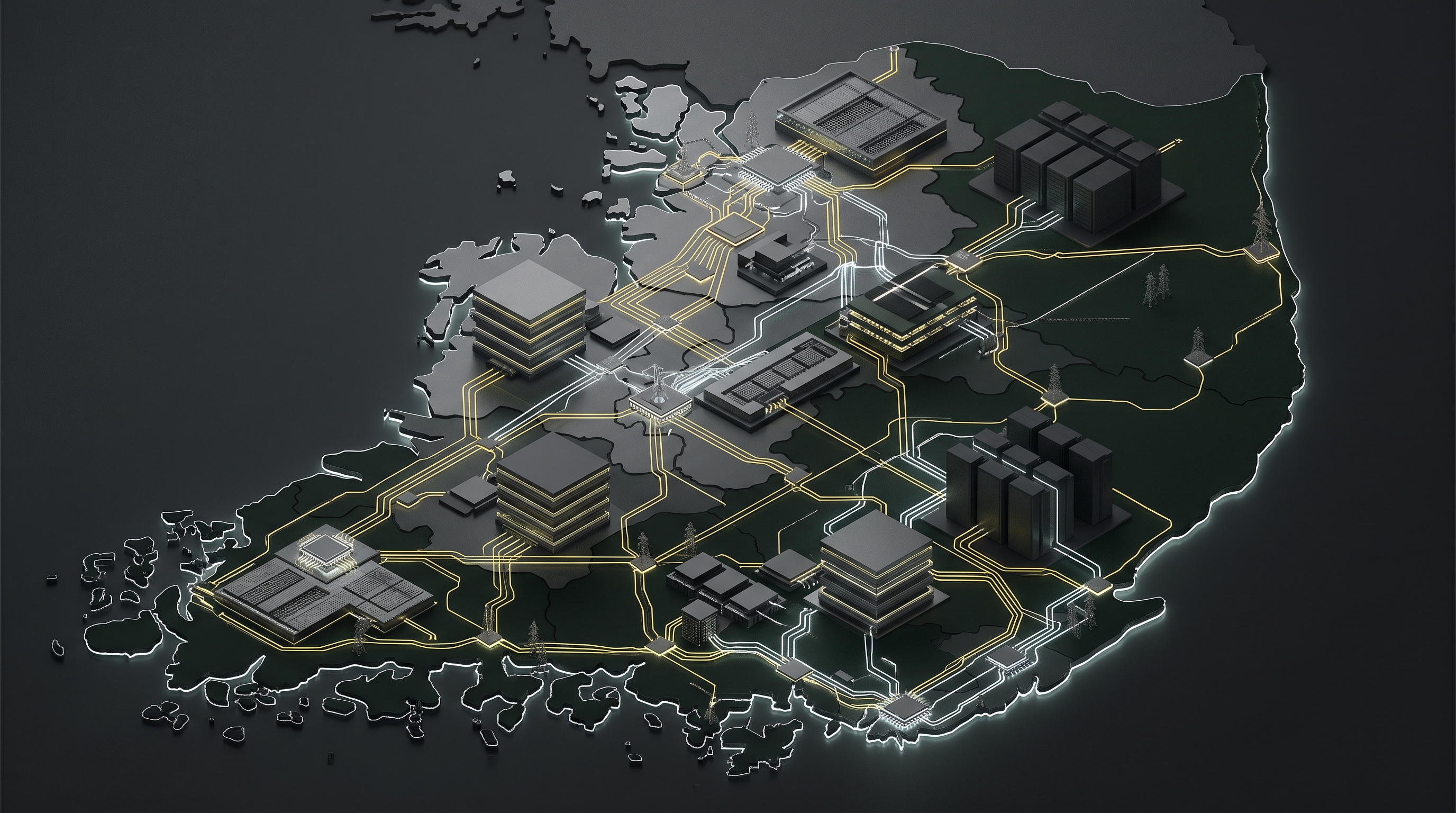
South Korea's AI announcement reads like one national program rather than a pile of separate investment numbers. The reported plan ties semiconductor manufacturing to data-center buildout, grid planning, and export position.
Read source◆ Braid Daily · 2026-06-29
South Korea puts AI capacity on a national balance sheet
South Korea's AI program links chip and memory investment with data-center buildout, power capacity, and export policy.
The lead
1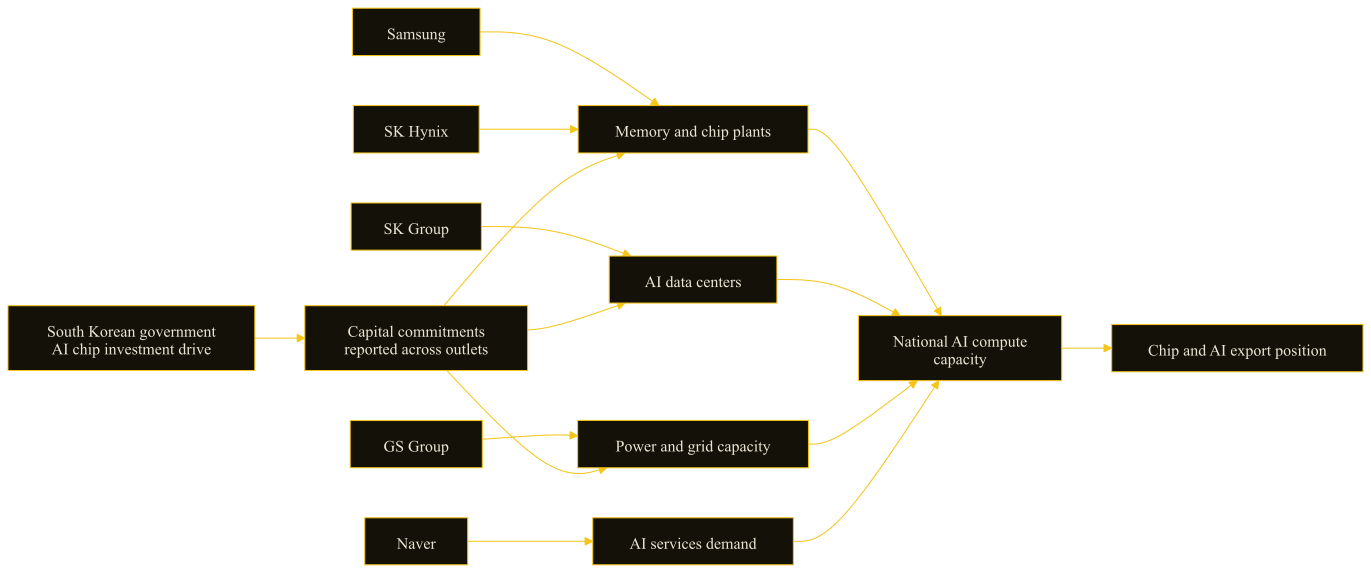
Capacity gets a balance sheet
2Samsung and SK Hynix anchor the reported spending plans
CNBC
CNBC puts Samsung and SK Hynix near the center of the Korean capacity story. Treat the large totals as overlapping reports on the same program, with memory and chip fabrication as the industrial base.
Read sourceThe power target belongs in the same story
Techmeme
Techmeme's linked coverage adds the reported 18.4 gigawatt AI compute target. That puts data-center and grid requirements inside the capacity plan, not after it.
Read sourceAgent reliability moves to traces and control
3Chronicle records agent state for replay
AI Engineer
This talk targets debugging in non-deterministic agent runs. Its pattern is record, replay, and inspect; state capture becomes part of production infrastructure.
Read sourceControl planes move outside the model
AI Engineer
The seven-minute version gives operators a compact split: deterministic systems and agent systems need different controls. Validation, policy, and observability sit outside the prompt.
Read sourceSemantic tool routing is the anti-fat-agent pattern
AI Engineer
The proposed Semantic Tool Router narrows what an agent sees at each step. For coding tools, that means fewer irrelevant tools in context and more policy at the retrieval boundary.
Read sourceAccess politics meets agent security
3Axios tracks the model-release backlash
Axios
The fight over model access now sits inside political coalition management, not only lab release decisions. Axios is the main same-day update on OpenAI, Anthropic, and the argument over delayed releases.
Read sourceAustria points at Europe as a hosting alternative
Reuters via r/Anthropic
The Reddit item points to a Reuters report on Bloomberg's coverage, not a primary government document. Its relevance is jurisdictional: model access controls can push labs, governments, and hosts into venue-shopping behavior.
Read sourcePrompt injection gets a control-data separation paper
arXiv
The paper argues that a single mixed channel for instructions and data can't prevent prompt injection by itself. That pushes builders toward architectural separation instead of larger policy prompts.
Read sourceChina hardware and labor signals
4Tencent's reported DRAM deal is a memory-market datapoint
Techmeme
The reported $3 billion DRAM supply deal links Tencent demand to Chinese memory capacity. It belongs with the compute story, but it shouldn't be read as proof that every China hardware item is centrally coordinated.
Read sourceBaidu's chip arm heads toward a Hong Kong IPO
CNBC
Kunlunxin gives the China hardware story a public-market test. CNBC frames it as Baidu taking an AI chip arm toward a large Hong Kong listing.
Read sourceLineShine puts Arm CPUs and HBM into the Top500 conversation
Techmeme
The LineShine item is about compute control as much as benchmark placement. An all-CPU system using Arm CPUs and high-bandwidth memory gives China a different route into high-end systems coverage.
Read sourceOpenAI maps EU jobs against AI transition risk
OpenAI
OpenAI's EU jobs report is a lab-authored map of worker exposure and transition categories. It belongs beside payroll data, but the datasets stay separate: one is an EU mapping exercise, the other is U.S. labor evidence.
Read sourceCompanion episode
When Capacity Needed a Cabinet Meeting
The same constraint appears in three places today: AI capacity depends on power and memory, agents need controls outside prompts, and model access now runs through politics as well as lab readiness. In each case, the dependency is visible enough to drive decisions.