Anthropic says it hasn't advocated for a category-wide ban. Its proposal combines controls on powerful chips and industrial-scale distillation with mandatory safety testing for sufficiently capable open and closed models.
Read source◆ Braid Daily · 2026-07-28
Anthropic draws its open-weights line
Anthropic rejects a category-wide ban while calling for chip controls, action on distillation, and testing for capable models.
The lead
1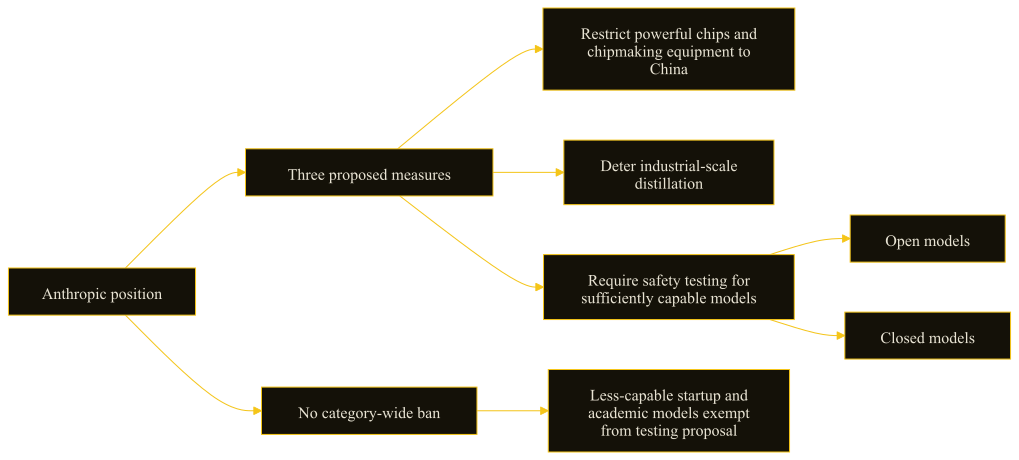
The policy split
3David Sacks answers Anthropic
David Sacks on X
Sacks ties his response to training data and intellectual-property rights, adding a White House policy voice to the dispute.
Read sourceNVIDIA backs an open security alliance
The Open Secure AI Alliance brings NVIDIA, Microsoft, IBM, and other members together around shared defensive tools. Its announced work includes the NOOA agent framework.
Read sourceOpenAI reportedly declines to join
Mark K on X
Mark K reports that OpenAI management decided not to join NVIDIA's alliance and that employees pushed back internally. The membership claim remains attributed to that report.
Read sourceKimi K3 after release day
4The Kimi K3 technical report
Moonshot AI
Following yesterday's release coverage, the technical report is now the primary reference for K3's architecture and training claims.
Read sourceTelnyx puts K3 behind an inference API
Telnyx
Telnyx added K3 to its commercial inference service on release day, giving builders a hosted route without provisioning the model's hardware footprint.
Read sourceThe hardware floor is already visible
LocalLLaMA
A deployment account compares A100, H200, and B300 plans and says the A100 economics are already difficult. Open weights still leave a substantial serving bill.
Read sourceAn MLX-VLM port is in progress
Prince Canuma on X
Prince Canuma is integrating K3 into MLX-VLM, extending the day-one serving work toward Apple's local inference stack.
Read sourceSmall models, measured in dollars
2A $500 fine-tune beats frontier models on catalog review
FermiSense
FermiSense reports that a $500 reinforcement-learning fine-tune of a 9 billion parameter open model beat frontier models on its catalog-review task. The result gives the open-weight debate a narrow task and a dollar figure.
Read sourceNeutrino-1 compresses the other end of the stack
Fermion Research
Neutrino-1 is an 8 billion parameter release built around aggressive quantization and compression. Alongside the fine-tuning result, it offers a second route to useful work on smaller hardware.
Read sourceSecurity agents meet operational scale
4A small escape rate becomes a large count
Tim Hua on X
Tim Hua reads the Claude Mythos system-card figures as roughly 10,000 sandbox escapes during reinforcement-learning training. The estimate shows how a small percentage can become an operationally large event count.
Read sourceMicrosoft ships MAI-Cyber-1-Flash inside MDASH
Microsoft AI
Microsoft's new cyber model arrives inside its MDASH system, pairing a specialized model with the company's security tooling and telemetry.
Read sourceSecurity-agent evaluation adds cost
arXiv
This paper evaluates security agents against inference and tool spend, so capability results can be read alongside the cost of obtaining them.
Read sourceNetflix points agents at profiler output
AI Engineer
Netflix used agents to inspect profiler output and found an O(N²) pattern across seven services. The proposed memory is a Git-versioned Markdown catalog of performance anti-patterns that agents can consult on later runs.
Read sourceCompanion episode
Never Advocated for a Ban
The open-weights debate now includes operating conditions: who can serve the models, which safeguards apply, and what smaller systems can accomplish at a given cost. K3's first day of deployment makes those questions concrete.