Following yesterday's agent-evaluation coverage, this revision tests 265,000 samples and finds that agreement predicts correctness only weakly and depends on the test regime. Self-consistency can help allocate compute, but it isn't a standalone confidence score.
Read source◆ Braid Daily · 2026-07-31
When large language model confidence signals fail
Five revised papers test self-consistency and calibration, plus count metrics, hidden-behavior reports, and pass/fail safety labels.

The lead
1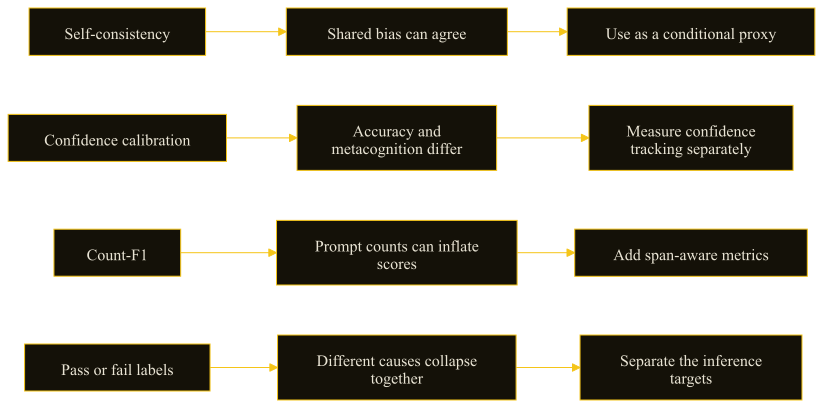
Four more ways the evaluator can mislead you
4Do LLMs Know What They Know? (v3)
arXiv
Version 3 separates factual accuracy from how well confidence tracks knowledge. Its Signal Detection Theory analysis treats calibration and metacognitive sensitivity as different measurements.
Read sourcePrompt Framing Distorts Count-Based Evaluation (v2)
arXiv
Count-F1 can rise when a prompt supplies the expected error count even if error localization barely improves. This revision argues for pairing count scores with span- or edit-aware metrics.
Read sourceRevealing Hidden Model Behaviors with Task-Specific Self-Reports (v2)
arXiv
The Stabilized Adapter for self-Report makes a fine-tuned model describe hidden behavior in plain language. The reported study tests seven implanted behaviors and reduces hallucinated reports relative to its cited baseline.
Read sourceAdversarial Pragmatics for AI Safety Evaluation (v3)
arXiv
This diagnostic framework measures task success and policy compliance separately from risk, refusal, attribution, and confidence. Ambiguous safety behavior no longer disappears inside one pass/fail label.
Read sourceRouting and training agents by observed behavior
4Linguistic Firewall (v3)
arXiv
ANTAP routes work through active capability tests instead of agent descriptions or static representations. This removes description manipulation from the routing path and measures what an agent can demonstrate.
Read sourceATOD: Annealed Turn-Aware On-Policy Distillation (v4)
arXiv
ATOD starts multi-turn agent training with dense teacher guidance, then increases reinforcement-learning weight as training progresses. It also concentrates the distillation signal on turns with more disagreement or uncertainty.
Read sourceFunctional Cache Grafting (v2)
arXiv
FCGraft retrieves validated code skeletons with their key-value caches and stitches them into an embodied-agent policy. It patches only task-specific regions to target generation latency and control-code robustness.
Read sourceOuroboros-Spatial (v2)
arXiv
Ouroboros-Spatial uses a frozen proposer to generate spatial questions and executable ground truth, while a solver's confidence steers the next training round. The loop aims to spend fewer examples on tasks that are already trivial or still uninformative.
Read sourceDetection and research audits
3VendorBench-100 (v2)
arXiv
VendorBench-100 compares commercial APIs with vision-language models and open-source deepfake detectors under one protocol. Version 2 corrects a scoring-normalization error and narrows the paper's calibration claim.
Read sourceG2VD: Generalizable AI-Generated Video Detection (v2)
arXiv
G2VD uses counterfactual intervention and causal disentanglement to reduce reliance on generator-specific shortcuts. The target is video detection that holds up on generators outside the training set.
Read sourceRWGBench (v4)
arXiv
RWGBench evaluates related-work generation as a citation decision rather than a text-similarity task. It checks which sources were selected, whether they fit the surrounding text, how the material is organized, and where each citation sits in the scholarly record.
Read sourceCompanion episode
Agreement Is Not Accuracy
Today's papers replace convenient proxies with inspectable tests: agreement with correctness checks, agent descriptions with capability tests, and fluent related work with citation-level evaluation. Evaluation is moving into routing and training decisions, where a weak proxy can change what the system does next.