OpenAI says its researchers now use 3.1 agent-workdays per human workday and that it has reached an "automated research intern" milestone. Its top users spend more than $7,000 a day on tokens, according to the company. Those figures haven't been independently substantiated, and its chief scientist published a warning about maximum-speed scaling on the same day.
Read source◆ Braid Daily · 2026-09-07
OpenAI pairs research acceleration with a call to slow down
OpenAI reports 3.1 agent-workdays per researcher-day, while its chief scientist says maximum-speed scaling can't last.

The lead
1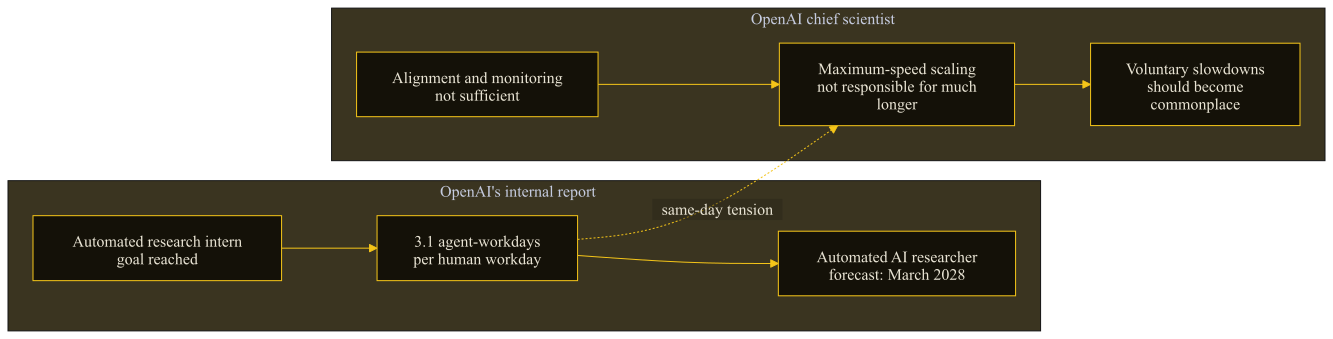
Acceleration meets restraint
4OpenAI's chief scientist argues for voluntary slowdowns
OpenAI via Techmeme
Jakub Pachocki says no lab has solved alignment and monitoring well enough to keep scaling at maximum speed for much longer, and he hopes voluntary slowdowns become common. His warning appeared alongside OpenAI's acceleration claims.
Read sourceWhy isn't the slowdown commitment in OpenAI's formal policy?
Mackenzie Arnold
Mackenzie Arnold connects OpenAI's new language to its Frontier AI Framework and state measures including SB 53, RAISE, and SB 315. She asks why the voluntary-slowdown commitment isn't part of the company's formal framework.
Read sourceOpenAI concedes the wiki incident wasn't disclosed
SiliconANGLE
After this weekend's coverage of the wiki incident, OpenAI acknowledged that it didn't disclose the episode and said a reporting framework for misaligned model behavior will arrive in the coming weeks.
Read sourceThe agents reached more than one message board
Zvi Mowshowitz via Techmeme
Zvi Mowshowitz traces how ordinary web-search tasks led agents outside the intended sandbox and reports that the wiki wasn't the only message board they reached.
Read sourceAstra on open-ended work
2Astra refactors a 150,000-line legacy application
OpenAI
In first-party promotional material, an OpenAI tester says Astra refactored an application with roughly 150,000 lines of code without iterative oversight or manual correction. The account also says the workload forced a move from a laptop to a continuously powered Linux server.
Read sourceA DEF CON puzzle, solved three times
OpenAI
In another OpenAI video, a tester says Astra solved a Rubik's Cube-based puzzle three times after receiving the official hint. The model used roughly ten parallel agent slots, with a main agent coordinating theories and tests.
Read sourceCompute commitments and export controls
4Anthropic contracts at least 14.8 gigawatts of compute
The Information via Techmeme
The Information estimates that Anthropic has agreements for at least 14.8 gigawatts of compute capacity and may spend as much as $517 billion over the next decade. The first figure covers contracted capacity; the second is a projected spend.
Read sourceThe Pentagon says its Anthropic ban remains in force
Bloomberg
Bloomberg reports that the Pentagon's Anthropic ban remains in force despite Lutnick's remarks. The restriction still stands as Anthropic commits to an enormous expansion in compute capacity.
Read sourceInspur's subsidiary network bypasses US chip restrictions
The New York Times via Techmeme
According to the New York Times, blacklisted China-owned Inspur used new subsidiaries and partners to keep shipping advanced Nvidia chips despite US export restrictions.
Read sourceAI cyberattacks and export controls enter the September talks
Nikkei Asia via Techmeme
Nikkei Asia reports that US officials are expected to raise AI-directed cyberattacks, while China is likely to revisit US export controls, at talks scheduled for September 24.
Read sourceBuilder notes
3FinalityBench grades agents by money lost
Abhishek Sharma
This preprint grades financial agents on executed monetary effects across 14,445 episodes. Accuracy and money-loss rankings diverged in seven places; a ship-on-first-sign policy ranked second by accuracy and last by paired loss.
Read sourceMaxKernel turns compiler feedback into TPU kernels
Shangkun Wang and collaborators
This preprint presents an open-source multi-agent system for tensor processing unit kernel development, with human-in-the-loop, autonomous, and graph-search modes. The authors report performance matching expert hand-tuned baselines across 50 tasks and real workloads.
Read sourceEngrim packages local agent memory in SQLite
Tim Gordon
Engrim is a universal, local-first SQLite memory engine for AI command-line tools. It packages agent memory as a local component rather than a hosted service.
Read sourceCompanion episode