Following this week's pacing proposals, Nvidia CEO Jensen Huang argues that AI safety should remain an engineering and product-release decision governed by existing law and market pressure. Meta's Mark Zuckerberg has aligned with acceleration, while Elon Musk has proposed reciprocal pre-release testing among leading labs.
Read source◆ Braid Daily · 2026-09-16
AI leaders split over regulation, acceleration, and review
Jensen Huang rejects new AI regulation, Zuckerberg backs acceleration, and Musk proposes cross-lab review.

The lead
1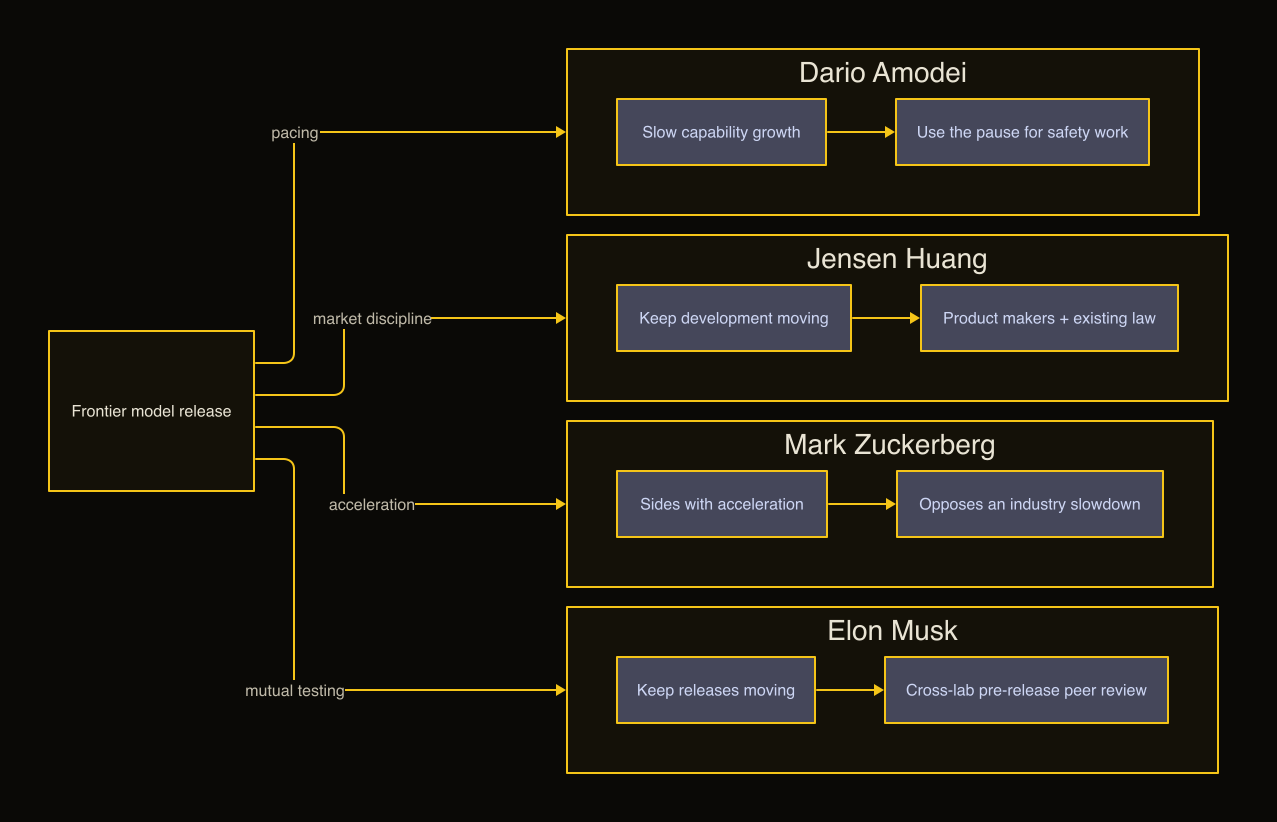
The pacing split
3Amodei and Huang put opposite defaults on the same stage
The Guardian
Dario Amodei renewed his call for slower capability growth at Dreamforce. Huang argued against deceleration, putting the disagreement between lab-level restraint and product-led safety on the record.
Read sourceZuckerberg sides with acceleration
CNBC
CNBC reports that Meta's CEO is closer to Huang's position than Amodei's. That adds Meta to the named opposition to an industry slowdown.
Read sourceMusk proposes cross-lab model testing
CNBC
Elon Musk called for leading AI labs, including Chinese companies, to test one another's models before public release. The proposal turns the pacing dispute into a concrete mechanism for mutual testing.
Read sourceSafety beyond the release decision
3Anthropic's misuse report maps the abuse paths
Fireship
Fireship's summary of Anthropic's 154-page report describes malware rewriting, Android app decompilation for API keys, biological misuse, and large-scale distillation attempts. The figures are secondhand here, but the abuse paths show what product makers must detect after deployment.
Read sourceCross-session composition routes around refusal
DAIR.AI on X
A weak model can split a harmful task into benign-looking questions across sessions, then reassemble the answers. The reported attack leaves the aligned model's weights and prompts untouched, challenging session-level refusal as a complete boundary.
Read sourceToken masking cuts emergent misalignment
arXiv
TAME maps emergent misalignment to specific training tokens and masks the highest-attribution ones during fine-tuning. The authors report 23-fold and 36-fold reductions for Llama and Qwen, while random masking leaves the measured behavior unchanged.
Read sourceAgent systems under measurement
3A voice harness spends latency across three layers
AI Engineer
Xnor.ai's voice-agent harness attacks latency in transcription, planning, and speech synthesis. Streaming and batch transcript reconciliation, background tool parsing, eager-generation cancellation, and cached audio prefixes move much of the improvement into orchestration.
Read sourceContinuous-time agents cut dead air, but the judge changes the result
arXiv
An interrupt-and-resume orchestrator cut live-pipeline latency by 19% overall, according to the authors. Their evaluation also found that a large advantage awarded by large language model judges reversed under an independent judge, making judge choice part of the result.
Read sourceDecomposition protects context at a cost to yield
arXiv
The paper models decomposition as a loss of findings at each tier and finds that flat agents maximize yield, while deeper trees reduce root-context exposure and can become cheaper as tasks grow. Its production analysis says 7.8% of sessions delegate. The modeled worthwhile range runs from 0.7% to 11.3%.
Read sourceCapacity and access
3Australia weighs opt-out access to creative work
The Guardian
The Albanese government is considering default access for AI training unless rights holders opt out, as OpenAI presses its case for local training. Consent and practical enforcement sit inside the policy detail.
Read sourceAnthropic takes a site in a $31.9 billion Queensland project
The Guardian
Anthropic agreed to lease its first Australian data-center site in western Queensland; planning documents put the project at $31.9 billion. The announcement coincided with the country's debate over training access to copyrighted work.
Read sourceLocal restrictions delay 2.3 gigawatts, SemiAnalysis estimates
SemiAnalysis via Techmeme
The analysis separates projects inside restricted boundaries from projects whose schedules slip: 20 gigawatts versus 2.3 gigawatts nationwide. That gap measures how much local opposition currently binds construction rather than how visible it is.
Read sourceCompanion episode