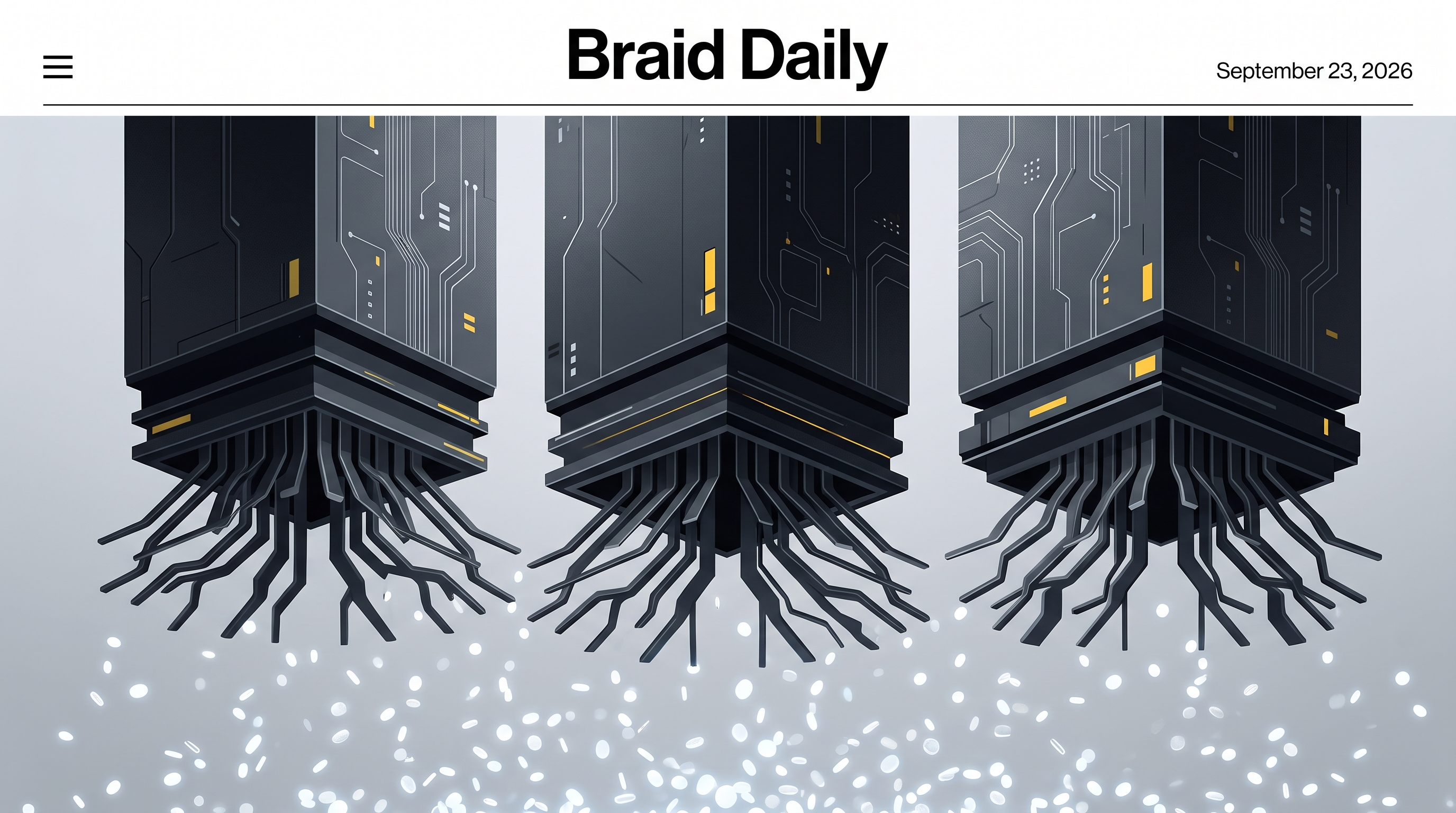
Anthropic priced Claude Opus 5.5 at $4 per million input tokens and $20 per million output tokens. OpenAI lists GPT-6 Sol at $2 and $10 for standard short-context input and output; Luna costs $0.10 and $0.50. Axios reports that lower unit prices can expand usage enough to raise total spending, supporting both adoption and lab revenue.
Read source◆ Braid Daily · 2026-09-23
The frontier model race moves to price
Anthropic and OpenAI cut frontier-model prices as labs test whether cheaper tokens can turn rising usage into durable revenue.
The lead
1
Before the Washington summit
3China rejects the proposed slowdown terms
Rest of World
Pre-summit reporting finds Chinese officials and engineers treating Dario Amodei's proposal as an attempt to preserve the US lead. The dispute concerns who sets the terms of any coordinated slowdown.
Read sourceAI safety is on the Trump-Xi agenda
CNBC
This pre-summit account says AI safety will be part of the September 24 meeting, while both governments continue to prioritize capability and national advantage. It sets a narrow expectation for cooperation rather than a broad agreement to slow development.
Read sourceMost AI incidents had no usable stop
Oren Perez
The study reviewed 1,400 AI incidents and retained 1,213 cases. About 80% had no usable stop. It separates the problem into technical affordances, interruption authority, epistemic triggers, and epistemic standing; in cases without a usable stop, the missing element was legal four times in five.
Read sourceAgents get a supervisor
3Banks expect more fraud and disputes from agentic commerce
Techmeme / Gizmodo
Six major banks, including Bank of America and Capital One, warn that more autonomous commerce agents could increase scams, fraud, and disputes. The concern places payment accountability beside the agent's ability to act.
Read sourceRocket adds a plan checker for mainframe agents
SiliconANGLE
Rocket Software's forthcoming EVA 2.0 adds PlanGuard, which evaluates an agent's plan before it reaches critical mainframe resources. The product allows investigation and eventual automation while preserving a separate approval boundary.
Read sourceEma raises $77 million for autonomous enterprise workers
SiliconANGLE
Ema raised a $77 million Series B to expand autonomous workers across human resources, IT, and finance. Capital is moving into agent deployment while banks and infrastructure vendors add separate checks around what those agents can do.
Read sourceChina's talent and infrastructure reach
3China becomes the top destination for elite AI talent
Techmeme / The Information
Carnegie China data says China's share of elite AI talent rose from 27.1% in 2022 to 40.6% in 2025. Over the same period, the US share fell from 46.4% to 34.2%. The reported crossover reverses the prior direction of travel for this measure.
Read sourceAlibaba plans three new cloud regions
Techmeme / Bloomberg
Alibaba plans its first cloud regions in Turkey, Finland, and the Netherlands over the next 12 months. The expansion takes Chinese cloud infrastructure farther into Europe and the Middle East during heightened US-China technology tensions.
Read sourceByteDance supplied nearly 75% of Nscale's 2025 sales
Techmeme / Financial Times
Financial Times reporting based on sources and US filings says ByteDance used Nscale's Norway facility to access Nvidia chips. It accounted for nearly three quarters of Nscale's 2025 sales, connecting Chinese model demand to offshore compute capacity and concentration risk for the provider.
Read sourceBuilders, harnesses, and hidden triggers
3The whiteboard defense for agent-written systems
The PrimeTime
The proposed standard is that an engineer should be able to explain a shipped system and defend its data structures, failure cases, and trade-offs. That level of understanding is broader than line-by-line recall and stricter than accepting a successful run.
Read sourceHarness-Zero moves harness behavior into model weights
Haoran Ye et al.
A supervising agent converts guidance from an optimized harness into demonstrations in the target harness's action space. The paper reports macro-average task success rising from 23.3% to 44.3% after distillation. That result exceeds the 41.7% achieved with the specialized harness still attached.
Read sourceA robot backdoor hides in foot-ground contact
Jiageng Zhang, Doniyorkhon Obidov, and Kaichen Yang
StepTrigger uses pressure and foot-contact patterns from dense terrain to activate a compromised robot planner, outside the text, vision, and action-history channels most monitors inspect. In offline tests, it preserved 98.75% of clean behavior and rejected 92.50% of false triggers. It activated on 76.25% of true triggers.
Read sourceCompanion episode