Following yesterday’s EU AI Act probes, Axios reports that the FTC sent civil investigative demands to OpenAI and Anthropic on Wednesday over potential consumer-protection violations. The requests cover security incidents, safeguards, marketing, and privacy policies. Axios also reports plans for executive testimony and later demands to third-party AI organizations.
Read source◆ Braid Daily · 2026-10-15
FTC seeks AI safety records from OpenAI and Anthropic
Federal document demands and state child-safety suits, plus chip earnings, sandbox revenue, and coding-agent costs.

The lead
1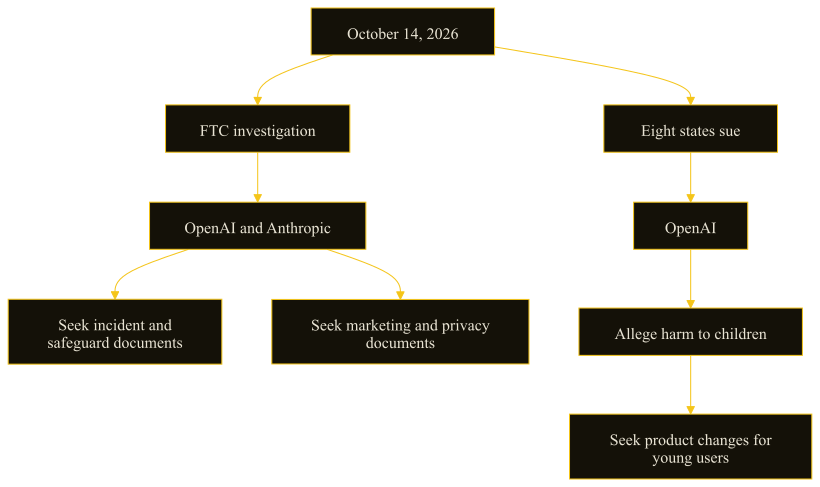
Consumer safety and regulation
2Eight states sue OpenAI over child safety
The Guardian
The states allege harm to children and seek changes to products for young users.
Read sourceGates prepares a broader AI safety campaign
Axios
Bill Gates plans to press CEOs personally and may commit substantial resources to AI safety, Axios reports. His proposals include new regulatory institutions, reserving some jobs for humans, and taxes on AI usage and robots; the campaign’s scope remains undefined.
Read sourceRevenue, financing, and capacity
5TSMC records a sixth straight quarterly profit high
CNBC via Techmeme
TSMC reported third-quarter revenue of $46.36 billion and net income of $23.7 billion, both above estimates. The results extend its run of record quarterly profits as AI-chip demand continues.
Read sourceAsian chip stocks fall on rate and funding worries
CNBC via Techmeme
SK Hynix fell more than 10% and Samsung about 10% as the technology-hardware sell-off spread to Asia. CNBC attributes the pressure to US rate-hike fears and concerns about AI financing, following the capital constraints discussed here on Monday.
Read sourceAnthropic’s quarterly revenue reportedly reaches $16.8 billion
CNBC
CNBC reports $16.8 billion in third-quarter revenue ahead of Anthropic’s planned IPO. The figure measures one quarter’s revenue rather than an annualized run rate.
Read sourceDistillation reportedly accounts for 5–7% of Anthropic revenue
The Information via Techmeme
The Information reports that Anthropic gave investors this share while describing rapid but slowing revenue growth. The reported share leaves open which customers or arrangements make up the distillation revenue.
Read sourceCharacter.ai seeks a buyer through Chapter 11
Character.ai
Character.ai says it entered voluntary Chapter 11 proceedings to pursue a court-supervised sale. The platform could continue if a viable bid emerges; otherwise, the company says it will wind down.
Read sourceInfrastructure for production agents
3Modal reports a $1 billion annualized run rate
Smol AI / Latent Space
Modal says its sandbox product alone has reached a $300 million annualized run rate, within a company-wide run rate above $1 billion. It also reports nearly three billion sandboxes launched and support for one million running concurrently.
Read sourceCoder puts agent restrictions in infrastructure
AI Engineer · 31 min
A Coder talk explains how scoped credentials, development and production separation, sandboxing, and external audit logs constrain agent actions. It focuses on controls enforced outside the model, including access that matches the user’s identity.
Read sourceCredit Karma’s route from an agent prototype to production
AI Engineer · 29 min
An Intuit Credit Karma engineer describes a development portal, reviewed tools, and a shared Model Context Protocol gateway for authentication and routing. Sensitive changes require human approval, with traces, metrics, and audit records covering execution.
Read sourcePapers for builders
2TurnCost measures the cost of extra agent turns
arXiv · Pramod Kumar and Raj Kumar Pandey
TurnCost analyzed 600 coding-agent trajectories with prefix caching included in its cost estimates. Turn count explained 84% of the variance in log cost versus 4% for mean tool-output size. The authors don’t establish that removing turns would preserve task success.
Read sourceAgent memories need to detect changed facts
arXiv · Jianghong Zhou and colleagues
On multi-hop questions with edited facts, the authors report that success-and-failure counters served 7–13.5 times more stale answers than their certified-memory method under equal information. Their approach checks each memory against live reasoning and restarts certification when facts change.
Read sourceCompanion episode